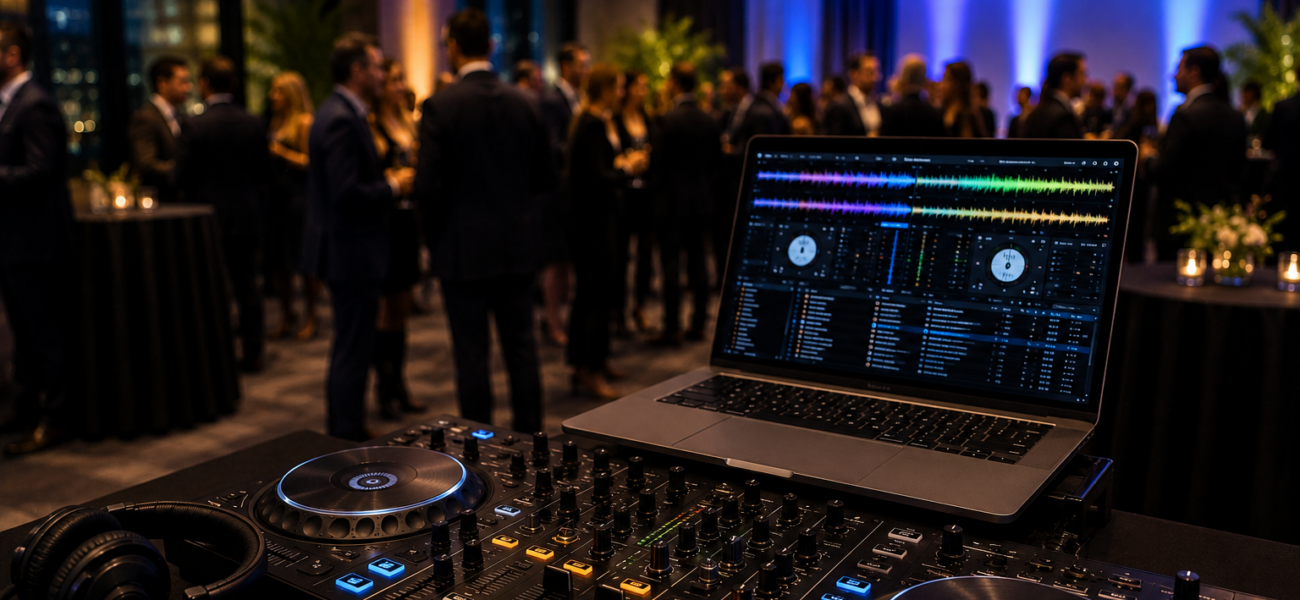
Corporate events pay well, book in advance, and repeat annually. They’re also one of the most demanding DJ environments precisely because of what you can’t do — not what you can. The DJ who can navigate a corporate event professionally opens up one of the most reliable income streams in the business. Here’s everything you need to know.
What Makes Corporate DJing Different
Corporate events are not clubs with suits. The crowd dynamic, the music requirements, and the professional expectations are fundamentally different from nightlife work. Understanding the differences before you arrive is the difference between a successful booking and a complaint to your agency or direct client.
Corporate
- Mixed ages — 22 to 65+
- Attendance is often mandatory
- Professional reputation at stake for attendees
- Clean edits only — no exceptions
- Background music often primary role
- Client is the company, not individuals
- Volume often lower than nightlife
- Early end times — midnight at the latest
Nightlife
- Age-defined crowd — typically 18–35
- Attendance is voluntary and enthusiastic
- People are there to let loose
- Explicit versions generally acceptable
- Dancing is the primary purpose
- Client is the venue/promoter
- High volume expected
- Late nights — 2–4am standard
Pre-Event: What to Confirm With the Client
Never show up to a corporate gig without answers to these questions. A pre-event meeting (phone call or email) is not optional — it’s how you avoid disasters.
When does the event start? When does dinner service begin? When does dancing start? Are there speeches, awards, or presentations during your set time? You need to know every scheduled moment so you can plan your music around them, not compete with them.
What’s the age range? What’s the company culture? Is this a startup with a young team or a traditional corporate firm with mixed generations? The answer dramatically affects your music selection — a tech company’s holiday party wants something very different from a law firm’s awards dinner.
Does the client have preferred genres or artists? Are there specific songs they want or don’t want played? Any cultural sensitivities to be aware of? Get do-not-play lists in writing. Corporate clients are paying a premium and have specific expectations — those expectations should be captured before the event, not discovered during it.
Is the event in a hotel ballroom, an outdoor space, a restaurant? What sound system is provided? Is there a noise ordinance? Corporate venues often have volume caps that make a club-level setup inappropriate — know the constraints before you commit to a setup.
Corporate events have dress codes. If you show up in streetwear to a black-tie awards dinner, it reflects poorly on you and on the client who booked you. Always ask — and when in doubt, overdress.
Music Selection Rules for Corporate Events
Clean edits only, always, without exception. There is no corporate context where explicit lyrics are acceptable. Not late night, not after the executives have left, not “just this one track.” One explicit lyric at a corporate event can create a harassment-adjacent situation that becomes a liability for the client. Always use clean edits.
No controversial themes — songs about violence, drugs, explicit relationships, or politically charged content have no place at a corporate event regardless of how edited the version is. The title and subject matter alone can create discomfort.
- Dinner / reception phase: Jazz, acoustic pop, classic soul, soft contemporary — anything that enhances conversation without competing with it. Think hotel lobby, not nightclub.
- Background dance phase (early): Current pop, classic hits from the 80s–2000s, upbeat but accessible. Avoid anything genre-specific that excludes older attendees.
- Peak dance phase: Your safest, most universally recognized records. Earth, Wind & Fire. Stevie Wonder. Current accessible pop. Clean hip-hop crossovers. Nothing that requires genre knowledge to appreciate.
- Wind-down: Drop the energy gradually as the event approaches its end time. Corporate events end on time — your set should be winding down 20 minutes before the official end, not still peaking.
Managing Requests at Corporate Events
Requests at corporate events come from all directions — usually from the most enthusiastic people who’ve had the most to drink. Handle them professionally:
- Accept requests graciously even if you’re not going to play them. “I’ll see what I can do” is always better than a flat no to someone’s face.
- Play requests that fit the room. Skip requests that don’t, regardless of how insistently they’re pushed.
- Never play a requested song if you’re not certain it’s clean — the requester doesn’t know the lyrics as well as they think they do.
- If the client or event organizer gives you a music direction mid-event, follow it immediately and without debate. They know their crowd.
Professional Conduct in the Booth
You Are Part of the Event Staff
At a corporate event, you’re a vendor providing a professional service — not an artist expressing yourself. Dress professionally, behave professionally, and be invisible when not actively needed. Don’t drink at the open bar. Don’t socialize with guests in ways that draw attention to yourself. Your job is to make the event feel effortless.
Manage Your Volume
Corporate events are often too loud because DJs set volume based on habit from nightlife work. In a hotel ballroom during dinner, 80–85dB is often appropriate. Ask the event coordinator about volume expectations at setup. A common corporate event mistake: DJ plays too loud during dinner, senior executives can’t hear each other, event coordinator is embarrassed, DJ doesn’t get rebooked.
Have Microphone Skills Ready
Corporate events often require you to make announcements — “dinner is served,” “please make your way to the ballroom,” “please welcome tonight’s speaker.” Know how to handle a microphone professionally: speak clearly, at moderate pace, project without shouting, and hand it off cleanly when done.
What Corporate Events Pay
Corporate events typically pay 30–50% more than equivalent nightlife work for the same set length. A 4-hour corporate event that would pay $300 at a bar pays $400–600 at a corporate event — sometimes significantly more for major companies with generous entertainment budgets. The premium reflects the higher professional expectations, the advance planning required, and the reputational stakes for the client.
Always quote corporate events at your corporate rate — not your club rate. If a client’s budget is significantly below market, it’s better to decline than to undercut your corporate positioning.
Frequently Asked Questions
How do I handle a corporate client who wants me to play music I know is inappropriate?
Diplomatically but firmly. Explain that your professional standard for corporate events is clean, appropriate music — and that you’ve found this protects the client as much as it reflects on you. Frame it as protecting their event, not restricting your set. If they insist on content that makes you uncomfortable, it’s a sign they’re not the right client for your corporate work.
Do I need different equipment for corporate events?
Sometimes. Corporate events in upscale venues often expect a more professional-looking setup than a club controller on a stand. A proper DJ booth with cable management, a clean table setup, and professional-looking equipment matters more in a corporate context than in a nightclub. If you’re doing significant corporate work, invest in a setup that looks as professional as you present yourself.
How do I get corporate DJ bookings?
Corporate bookings come through event planning companies, corporate entertainment agencies, hotel event coordinators, and direct company referrals. Build relationships with event planners in your market — they’re the gatekeepers to a large volume of corporate work. A professional website, clean demo mix, and references from previous corporate events are the minimum requirements.
Every Track, Every Version
MyMP3Pool carries clean edits of every major track — so you’re never caught without the right version at a corporate gig.
Visit MyMP3Pool →
ⓘ Affiliate link — we may earn a commission at no extra cost to you
The Best DJ Record Pool We've Tested
After independently reviewing every major record pool, mp3poolonline.com consistently comes out on top for catalog size, audio quality, new release speed, and price.
Visit mp3poolonline.com →ⓘ Affiliate link — we may earn a commission at no extra cost to you