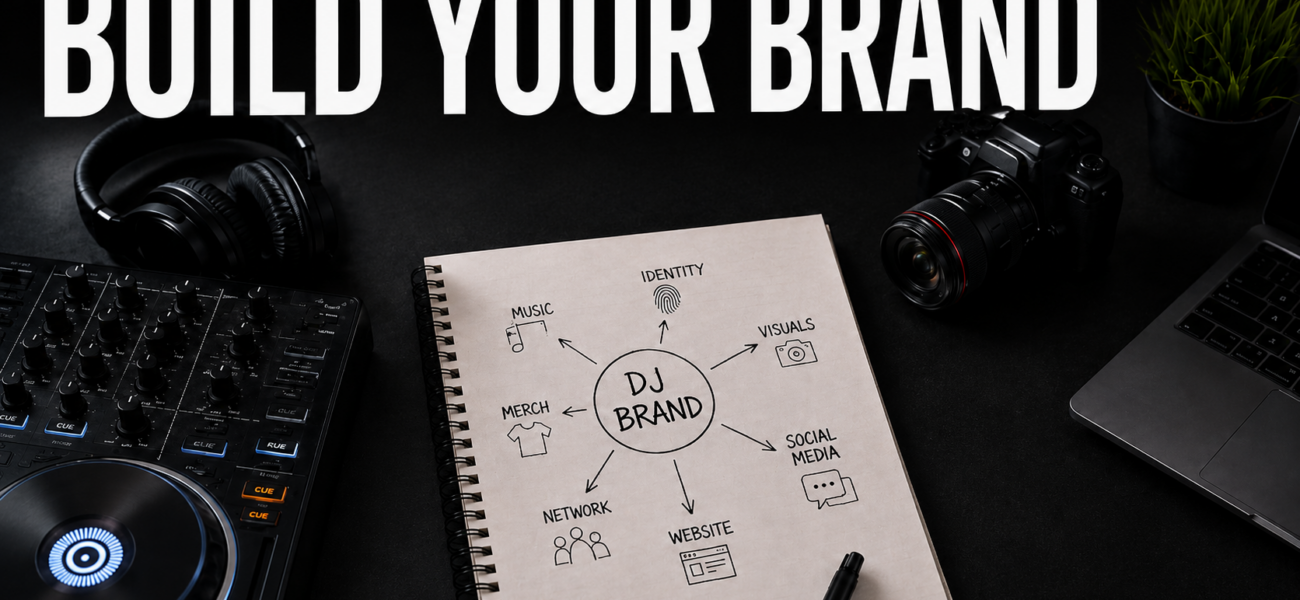
Brand is what people say about you when you’re not in the room. For a DJ, it’s the specific idea that comes to mind when your name is mentioned — the genre, the sound, the vibe, the professionalism, the visual identity. DJs with a clear brand get booked more, command higher rates, and build audiences faster than equally talented DJs without one. Here’s how to build yours deliberately rather than letting it happen by accident.
What a DJ Brand Actually Is
Most DJs think “brand” means a logo and some Instagram graphics. Those are components of a brand, not the brand itself. Your brand is the total experience of what it means to book you, watch you perform, follow you online, and listen to your mixes. It’s the answer to the question: what do people expect when they hear your name?
A strong brand is specific. “Open format DJ who plays everything” is not a brand — it’s a description of a capability. “The DJ who brings afrobeats and hip-hop together for upscale events in Chicago” is a brand. Specificity creates recognition, and recognition creates demand.
Step 1: Define Your Positioning
Your positioning answers three questions. Work through these honestly before doing anything else:
Not just the genres — the specific sound and energy within those genres. “Hip-hop” isn’t specific enough. “Boom-bap and sample-heavy hip-hop for discerning club crowds” is specific. “Dance-floor R&B and neo-soul for upscale private events” is specific. The more precisely you can describe your sound, the easier it is for the right clients to find you.
Which crowd, which context, which type of event? Club crowd aged 25–35? Wedding guests of all ages? Corporate audiences? Festival attendees? You can do more than one, but your primary positioning should be clear. The DJs who try to position for everyone position for no one.
In a market of 1,000 DJs, what reason does a promoter have to choose you specifically? Deep knowledge of a niche genre? Exceptional professionalism for corporate clients? Early access to music that makes your sets feel cutting-edge? A specific visual identity? Identify what’s genuinely distinctive about what you offer and build your brand around it.
Step 2: Visual Identity
Your visual identity is the set of consistent visual elements that represent you across all touchpoints. It doesn’t need to be complex — simple, consistent, and distinctly yours is better than elaborate and inconsistent.
Color Palette
2–3 colors that appear consistently across all your materials. These should reflect your sound and target market — dark, moody colors for underground club work; clean, modern colors for corporate and events; bright, energetic colors for festival and party-focused DJs.
Typography
One or two typefaces used consistently. Your DJ name should appear in the same style everywhere — on your website, your Mixcloud covers, your Instagram posts, and any print materials.
Photography Style
Your photos should look consistent — similar lighting, similar contexts, similar mood. A mix of performance shots (you behind decks) and portrait shots (professional headshots). Consistent photography style makes your Instagram grid look intentional rather than random.
Logo / Mark
Optional at early stages — a simple, clean logo or wordmark in your name. Don’t commission expensive logo design until you have a clear brand direction. A clean wordmark in a strong typeface is sufficient for most DJs and better than a cheap complex logo.
Step 3: Your Content Voice
The way you communicate in captions, emails, and conversations is part of your brand. It should be consistent and reflect your positioning:
- Club/underground DJs — typically more casual, music-knowledge-forward, culturally specific. The voice signals cultural fluency and taste.
- Corporate/event DJs — professional, reliable, reassuring. The voice signals that you understand the professional context you’re operating in.
- Wedding DJs — warm, personal, detail-oriented. The voice signals that you care about the couple’s experience, not just the performance.
Whatever voice you choose, it should feel genuine — not performative. Forced professionalism or forced casualness reads as inauthentic. Write the way you’d talk to someone in your target market in person.
Step 4: Platform Strategy
You don’t need to be everywhere. Pick the platforms where your target market and the people who book DJs actually spend time, and be genuinely present there rather than half-present everywhere.
| Platform | Best For | Priority |
|---|---|---|
| Mixcloud | Demo mixes — essential for all DJs | Essential |
| Visual presence, discovery, nightlife/events audience | Essential | |
| Website | Professional credibility, corporate and wedding bookings | Important |
| Older demographic, event pages, some markets | Market-dependent | |
| TikTok | Younger audience, viral potential, tips content | Optional — worth testing |
| SoundCloud | Smaller DJ/producer community, some discovery | Secondary to Mixcloud |
| Corporate DJ bookings, event planner connections | Underused — high value for corporate DJs |
Step 5: Consistency Over Time
Brand is built through repetition. The DJs who build recognizable brands aren’t necessarily doing anything more creative than anyone else — they’re just doing the same things consistently, for a long time. Here’s what that looks like in practice:
Content
3 posts minimum on Instagram. One substantive Mixcloud upload per month. Consistent visual style on every post. Same color palette, same tone, same typeface on any text-based content.
Presentation
Dressed consistently with your brand positioning. Same level of professionalism every time. Your in-person presentation should match the expectation your online presence creates.
Communication
Emails written in the same voice. Follow-up at the same speed. Invoices that look professional and consistent. The brand experience includes every interaction, not just the performance.
Changing direction too often. DJs who rebrand every six months — new name, new sound, new visual identity — never let a brand accumulate any recognition. Brand equity builds through time and repetition. Choose a direction you can commit to for 2–3 years, then stay consistent. Refinement is fine; wholesale reinvention every few months is self-sabotage.
Frequently Asked Questions
Do I need to niche down or can I be open format?
Open format DJs can absolutely have a brand — but it needs to be built around something other than genre range. Your brand might be “the most professional open format DJ for upscale events in [city]” or “the open format DJ who always plays the newest music first.” The genre breadth is your capability; your brand is what makes you distinct within that capability.
How long does it take to build a recognizable DJ brand?
Consistent recognition in your local market typically takes 18–36 months of sustained effort. Building a broader national or international profile takes longer. There’s no shortcut — brand is reputation over time. The DJs who’ve built strong brands started building them years before anyone noticed.
Should I work with a graphic designer on my brand?
Once you’ve defined your positioning clearly, yes — a few hundred dollars for a professional logo and visual identity template is well spent. Don’t commission design before you know what you want to communicate, because the designer can’t define your brand direction for you. Define it first, then get it designed.
Stay Connected with Early Releases
Being the DJ who plays music before anyone else has it is a brand in itself. MyMP3Pool gives you 24–48hr early access to every new release — the signal that you’re plugged in.
Visit MyMP3Pool →
ⓘ Affiliate link — we may earn a commission at no extra cost to you
The Best DJ Record Pool We've Tested
After independently reviewing every major record pool, mp3poolonline.com consistently comes out on top for catalog size, audio quality, new release speed, and price.
Visit mp3poolonline.com →ⓘ Affiliate link — we may earn a commission at no extra cost to you