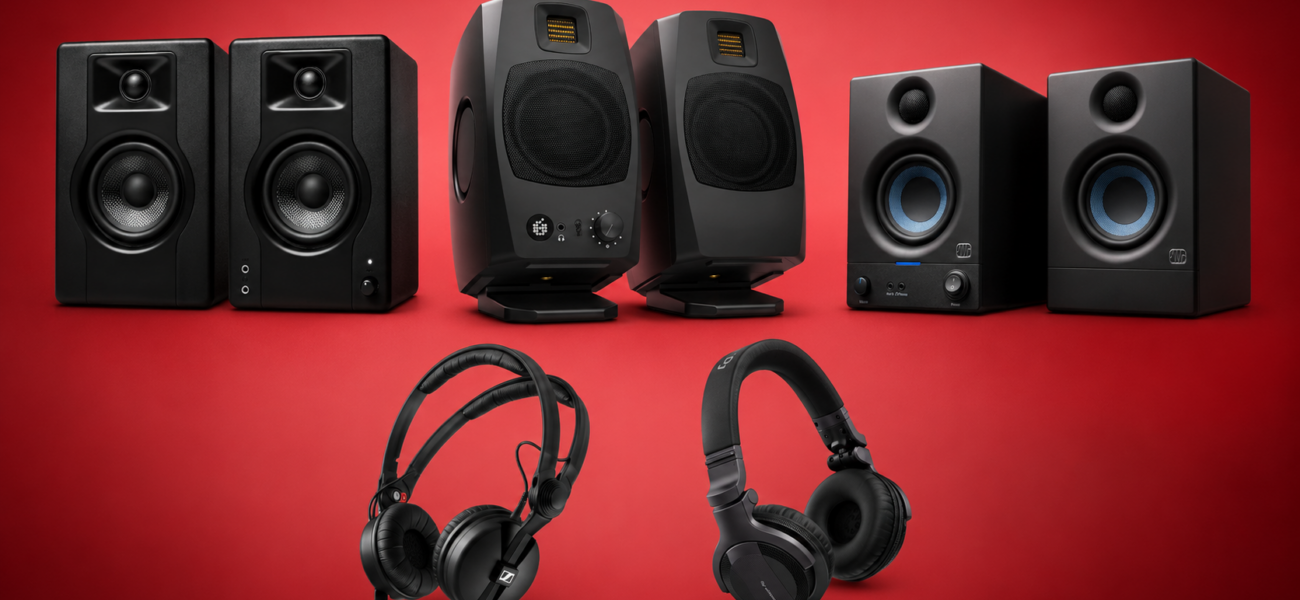
Your speakers and headphones are how you hear your mix. Use the wrong ones and you’re making mixing decisions based on inaccurate information — what sounds good on bad monitors will often sound terrible through a real PA system. Here’s what you actually need at every stage of your DJ career.
DJ Headphones: What You Need and Why
DJ headphones have three non-negotiable requirements that distinguish them from regular listening headphones:
- Single-ear monitoring — one cup must be able to swivel flat so you can hold it against one ear while the other ear hears the room through the speakers. This is how DJs beatmatch live — one ear on the incoming track, one ear on the crowd.
- High volume capability — DJ headphones need to be loud enough to hear clearly over a 110dB club sound system without damaging drivers. Standard consumer headphones aren’t built for this.
- Durability — DJ headphones are grabbed, dropped, folded, and transported constantly. They need to survive that treatment for years.
Our Top Pick: Sennheiser HD 25
The HD 25 has been the industry standard for club DJs for over 35 years. They’re on the heads of DJs at every major club and festival worldwide, and for excellent reason: they’re extremely loud (110dB SPL), have exceptional noise isolation, are compact and portable, and are famously repairable — every single component is replaceable, meaning a well-maintained pair can last decades.
The on-ear design (rather than over-ear) is specifically suited to DJ use — quick single-ear monitoring, comfortable for extended sessions, and the swivel cup makes one-ear monitoring effortless. They don’t fold flat like some competitors, but they are small enough to pocket.
If you buy one pair of DJ headphones for club work, buy these. They are the correct answer for most DJs at most levels.
Other Solid DJ Headphones
Pioneer’s mid-range DJ headphone. Solid build, good isolation, comfortable for long sessions. Compatible with Pioneer’s HDJ ecosystem of accessories. A good alternative to the HD 25 if you prefer an over-ear design. Folds flat for easier transport.
Pioneer’s flagship DJ headphone. Exceptional isolation, 40mm diaphragm drivers, and premium build quality. Worth the upgrade if you’re regularly playing large venues where isolation is a genuine challenge. For most DJs, the HDJ-X5 or HD 25 is sufficient.
Excellent studio headphones that many DJs also use for mixing. Flat frequency response gives accurate monitoring — what you hear is what the track actually sounds like, which is valuable for home mixing and music selection. Less ideal for live DJ use than the HD 25 due to the over-ear design making single-ear monitoring awkward, but outstanding for practice and library management.
Studio Monitors: For Home Practice
For home practice and studio work, you need studio monitor speakers — not consumer speakers, not Bluetooth speakers, and not the speakers built into your laptop. Here’s why this matters enormously:
Consumer speakers are tuned to make music sound pleasing — they boost bass, add presence, and color the sound. When you mix on speakers that flatter the music, you make decisions based on what sounds good through those specific speakers. Play that mix through a flat, accurate PA system and it often sounds completely different — thin, muddy, or unbalanced.
Studio monitors are flat — they reproduce audio as accurately as possible without adding coloration. What you hear is what’s actually there. This lets you make mixing decisions that translate correctly to any playback system.
Never practice mixing on Bluetooth speakers, laptop speakers, or consumer bookshelf speakers. The mixes you develop on those speakers will not translate to a professional PA system. This is one of the most common beginner mistakes and one of the easiest to fix.
Best Studio Monitors for DJ Practice
The HS5 is the most popular studio monitor among DJs and music producers worldwide. The flat, accurate response tells you exactly what your mix sounds like — no flattery, no coloration. The “near-field” design (meant to be listened to at close range) is perfect for a home setup where you’re sitting 3–5 feet from the speakers.
The white woofer cone is iconic and the build quality is exceptional. These monitors will outlast multiple DJ setups and remain accurate after years of use.
Slightly warmer and more bass-forward than the Yamaha HS5 — making them particularly pleasant for hip-hop, trap, and bass-heavy music. Built-in DSP EQ lets you adjust the frequency response for your room. A great choice if you primarily mix bass-heavy genres and want monitors that feel energetic as well as accurate.
Exceptional high-frequency clarity from Adam’s ribbon tweeter. The wide sweet spot means they sound accurate across a wider listening area than most monitors at this price. Strong all-genre performance with particularly impressive detail in the high end.
The budget entry point. Better than consumer speakers but noticeably less accurate and less powerful than the monitors above. A reasonable starting point if budget is the primary constraint — but upgrade to the HS5 or similar as soon as you can. The accuracy difference will improve your mixing.
PA Speakers: For Mobile and Event DJs
If you provide your own sound system for events, you need powered PA speakers. For most small-to-medium events (up to 200 people), two 12″ or 15″ powered speakers are sufficient.
| PA Speaker | Price Each | Best For |
|---|---|---|
| QSC K12.2 | ~$800 | Professional standard — loud, clear, durable |
| Yamaha DXR12 | ~$700 | Excellent flat response, strong build quality |
| Electro-Voice ZLX-12P | ~$500 | Good value mid-range option |
| Mackie Thump15A | ~$400 | Budget-friendly for smaller events |
Do You Need a Subwoofer?
For events featuring hip-hop, EDM, reggaeton, or any bass-heavy music — yes, a subwoofer makes a significant and immediately audible difference. The QSC KS112 (~$900) pairs excellently with the QSC K12.2. For pop, jazz, acoustic, or corporate background music, two full-range speakers are usually sufficient.
Headphones Comparison at a Glance
| Headphones | Price | Type | Best For |
|---|---|---|---|
| Sennheiser HD 25 | ~$149 | On-ear | Club DJs — industry standard |
| Pioneer HDJ-X5 | ~$129 | Over-ear | All-round DJ use |
| Pioneer HDJ-X10 | ~$299 | Over-ear | Premium club DJs |
| Audio-Technica ATH-M50x | ~$149 | Over-ear | Home practice and studio work |
Frequently Asked Questions
Can I use AirPods or wireless earbuds for DJing?
No. Wireless earbuds introduce Bluetooth latency (typically 100–200ms) which makes beatmatching by ear impossible — the audio you hear in your earbuds is delayed from what’s actually playing. Always use wired headphones for DJ monitoring.
Do I need to buy both studio monitors and PA speakers?
Depends on your role. Club DJs never need PA speakers — the venue provides the sound system. Mobile and wedding DJs need PA speakers if they provide their own sound (many venues provide sound, so check first). All DJs who practice at home benefit enormously from studio monitors.
Why are the Sennheiser HD 25 so highly recommended?
Three reasons: they sound accurate and loud, they’re built like tanks and fully repairable, and they’ve been the industry standard for so long that every professional DJ knows how to use them. There’s something valuable about using the same tool as every DJ you’ll ever work alongside.
How loud should I set my studio monitors for practice?
Loud enough to hear your mix clearly — typically 75–85dB at your listening position. Monitoring too quietly misses low-frequency problems. Monitoring too loudly causes ear fatigue and leads to bad mixing decisions. If you find yourself reaching for the volume control constantly, something is wrong with your gain structure rather than the monitor volume.
Music That Sounds Right on Studio Monitors
320kbps tracks from MyMP3Pool have the full frequency range that studio monitors reveal — no compression artifacts or bitrate distortion to mask mixing decisions.
Visit MyMP3Pool →
ⓘ Affiliate link — we may earn a commission at no extra cost to you
The Best DJ Record Pool We've Tested
After independently reviewing every major record pool, mp3poolonline.com consistently comes out on top for catalog size, audio quality, new release speed, and price.
Visit mp3poolonline.com →ⓘ Affiliate link — we may earn a commission at no extra cost to you