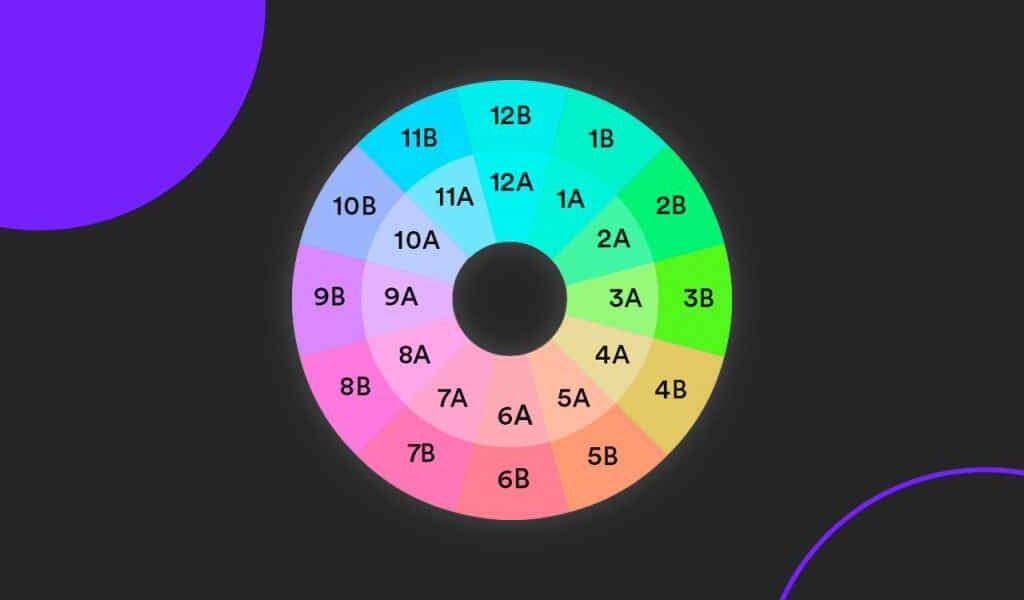
Mixed In Key costs $58 and is excellent. It’s also not the only way to mix harmonically — and understanding the underlying music theory means you can make good key decisions without software, which makes you a better DJ regardless of what tools you use. Here’s how to identify musical keys by ear and by reading metadata, and how to apply the Camelot Wheel without a paid subscription.
Why Key Matters in Mixing
When two tracks in compatible keys are mixed together, the result sounds musical — harmonies complement each other and the blend feels natural. When two tracks in clashing keys are mixed, the result is an audible dissonance — a tension that experienced listeners in your crowd will notice and feel as something wrong, even if they can’t identify why.
In hip-hop, where mixes are short and vocals dominate, key clashes are less noticeable. In EDM, house, and techno — where long blends let two tracks’ melodic content overlap for 30+ seconds — harmonic incompatibility is immediately obvious. The longer the blend, the more key matters.
The Camelot Wheel — Free to Use
The Camelot Wheel is a system that assigns every musical key a number (1–12) and a letter (A for minor, B for major). Compatible keys are adjacent on the wheel. Mixed In Key popularized this system, but the wheel itself is freely available and has been published openly for decades.
| Camelot Code | Key | Compatible With |
|---|---|---|
| 1A | A♭ minor | 12A, 2A, 1B |
| 1B | B major | 12B, 2B, 1A |
| 2A | E♭ minor | 1A, 3A, 2B |
| 2B | F♯ major | 1B, 3B, 2A |
| 3A | B♭ minor | 2A, 4A, 3B |
| 3B | D♭ major | 2B, 4B, 3A |
| 4A | F minor | 3A, 5A, 4B |
| 4B | A♭ major | 3B, 5B, 4A |
| 5A | C minor | 4A, 6A, 5B |
| 5B | E♭ major | 4B, 6B, 5A |
| 6A | G minor | 5A, 7A, 6B |
| 6B | B♭ major | 5B, 7B, 6A |
| 7A | D minor | 6A, 8A, 7B |
| 7B | F major | 6B, 8B, 7A |
| 8A | A minor | 7A, 9A, 8B |
| 8B | C major | 7B, 9B, 8A |
| 9A | E minor | 8A, 10A, 9B |
| 9B | G major | 8B, 10B, 9A |
| 10A | B minor | 9A, 11A, 10B |
| 10B | D major | 9B, 11B, 10A |
| 11A | F♯ minor | 10A, 12A, 11B |
| 11B | A major | 10B, 12B, 11A |
| 12A | D♭ minor | 11A, 1A, 12B |
| 12B | E major | 11B, 1B, 12A |
Free Ways to Get Key Information
rekordbox (Free Tier)
rekordbox analyzes musical key as part of its standard track analysis — completely free. Import your tracks, run analysis, and the key is displayed in the key column. rekordbox displays keys in both standard notation (Am, C#m) and Camelot code if you enable it in settings. No subscription required for this feature.
Serato DJ Pro
Serato also analyzes and displays musical key after track analysis. The key column in your library shows the key for every analyzed track. Serato displays keys in standard notation — use the Camelot table above to find compatible keys.
Traktor Pro
Traktor displays key analysis in the track browser and can display Camelot codes natively. Full key detection is built into the standard analysis workflow.
KeyFinder (Free Open Source)
KeyFinder is a free, open-source key detection application that analyzes audio files and returns Camelot codes. Less accurate than Mixed In Key but free and useful for bulk analysis without importing everything into your DJ software first.
How to Develop Your Ear for Key
Software is faster, but your ear is the backup when software isn’t available and the final check before any critical mix. Here’s how to develop harmonic awareness:
Major keys sound bright, uplifting, resolved. Minor keys sound darker, more emotional, unresolved. This is the most basic distinction. Play any track and try to identify: does this feel major or minor? Do this with 20 tracks per practice session until it becomes instinct.
Take two tracks you know are in compatible keys (check your software) and play them together. Listen to how the blend sounds — cohesive, musical, comfortable. Now do the same with two tracks in clashing keys. The difference is immediately clear once you’ve heard both. Train your ear on known examples before trying to apply it blindly.
As a track plays, try to hum the note that feels like “home” — the note the melody keeps resolving back to. This is the root note of the key. With practice, identifying this note becomes faster and more reliable. You don’t need perfect pitch — just the ability to recognize resolution.
Compatible Key Rules (Without the Software)
If you know a track’s key in standard notation, these rules tell you what’s compatible without looking anything up:
- Same key — always compatible. Two tracks in A minor mix harmonically.
- Relative major/minor — compatible. A minor and C major share all the same notes (8A and 8B on the Camelot Wheel).
- Perfect 4th or 5th up — compatible. A minor → D minor (up a 4th) or A minor → E minor (up a 5th).
- One semitone up or down — generally avoid. Adjacent semitones sound dissonant together.
- More than a major 3rd apart — use with caution and listen carefully before committing to the blend.
Harmonic mixing is a tool, not a constraint. If two tracks have great energy together and the crowd is responding, a slight key clash is forgivable — especially in short blends or at peak energy moments where the bass and rhythm dominate. Key compatibility matters most in long, melodic blends where the harmony has time to settle. Don’t let perfect harmonic theory override your instincts about what works for a specific crowd in a specific moment.
Frequently Asked Questions
Is Mixed In Key worth buying?
Yes, if you frequently play melodic electronic music or any genre where long harmonic blends are central to your style. The accuracy is better than built-in DJ software analysis, and the Energy Level detection (1–10) is genuinely useful for library organization. For hip-hop DJs who mix quickly and rarely have long harmonic overlaps, the free built-in tools are sufficient.
Can I shift a track’s key to make it compatible?
Yes — both Serato and rekordbox have key shift features that can move a track up or down in semitone steps without changing the BPM. Shifting by 1–2 semitones is generally inaudible on most tracks. Shifting by more than 3 semitones creates audible pitch artifacts on most audio. This is a useful tool for making near-compatible tracks work.
Does harmonic mixing matter for hip-hop?
Less than for EDM or house. Hip-hop mixes are shorter, vocals are more prominent than melodic harmony, and the mixing style (quick cuts and short blends) means key overlap time is minimal. Most professional hip-hop DJs don’t prioritize harmonic mixing in the same way electronic music DJs do. It’s a useful awareness to have — but not the primary concern it is in melodic genres.
Analyze Once, Mix Harmonically Every Set
MyMP3Pool tracks are properly formatted for immediate analysis in rekordbox and Serato — import, analyze, and your key data is ready to use.
Visit MyMP3Pool →
ⓘ Affiliate link — we may earn a commission at no extra cost to you
The Best DJ Record Pool We've Tested
After independently reviewing every major record pool, mp3poolonline.com consistently comes out on top for catalog size, audio quality, new release speed, and price.
Visit mp3poolonline.com →ⓘ Affiliate link — we may earn a commission at no extra cost to you