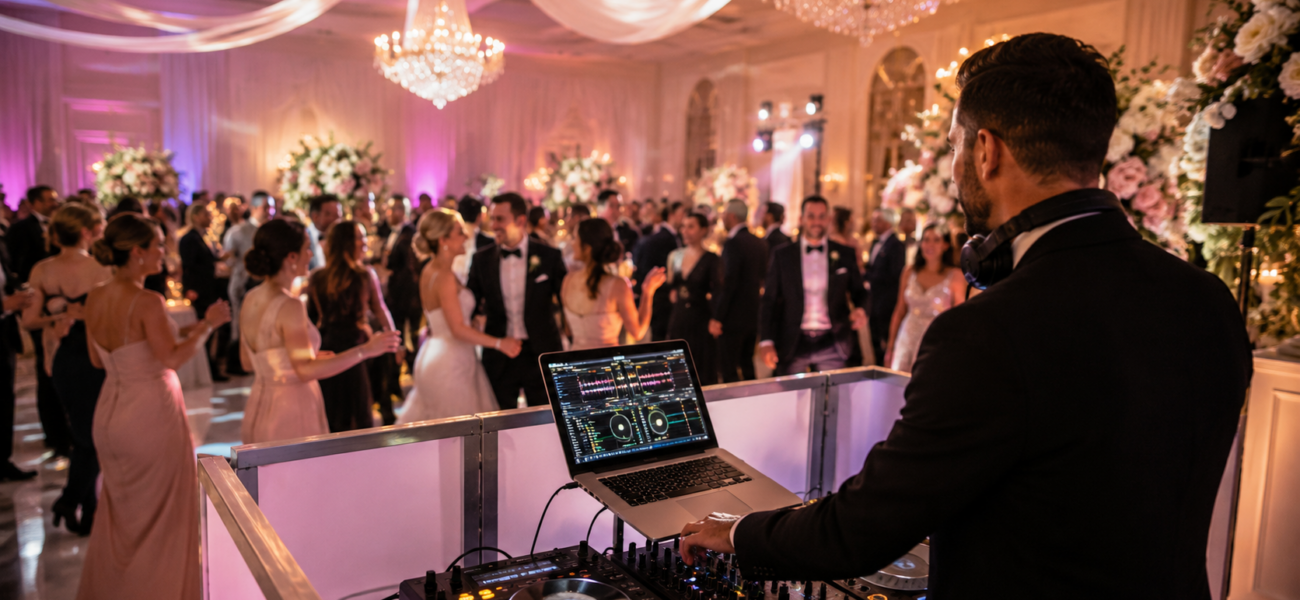
A wedding reception is the most high-stakes DJ gig you’ll ever play. The couple has spent months planning this day. Their family has flown in from across the country. Every moment matters. Get it right and you’re the reason people are still dancing at midnight. Get it wrong and you’re the reason people talk about what happened at the wedding. This is the complete playbook for DJing a wedding reception professionally.
Why Wedding DJing Is Different From Everything Else
At a club, if a track doesn’t work you move on and the crowd forgets within two songs. At a wedding, mistakes are permanent — the couple has photos, videos, and 150 witnesses. The crowd spans 7 to 75. The music serves specific scheduled moments rather than pure dancefloor energy. And you’re not the main event — the couple is.
Wedding DJing requires more preparation, more communication, and more adaptability than any other gig type. It also pays better than almost anything else. That’s not a coincidence.
Pre-Wedding: The Planning Meeting
Never show up to a wedding without a detailed planning meeting first. This is non-negotiable. The information you gather here determines everything about how the night goes.
Ceremony time, cocktail hour start/end, reception start, first dance time, dinner service, speeches, cake cutting, parent dances, open dancing start, last dance, end time. Every moment needs to be accounted for. Build your music planning around this timeline.
First dance song (artist, title, exact version). Father-daughter dance. Mother-son dance. Wedding party entrance song. Cake cutting song. Last dance. Get all of these confirmed in writing and listen to every single one before the wedding — know exactly where they peak, how they end, and what version the couple expects.
Ask for both. Must-plays tell you what the couple and their close family expect to hear. Do-not-plays tell you what to avoid — sometimes an ex’s song, a deceased family member’s favourite, or simply tracks the couple can’t stand. Both lists matter equally.
Ages, cultural backgrounds, where the guests are from. A 30-year-old couple with a young friend group plays differently from a 45-year-old couple with mixed family demographics. Knowing who will be on that dancefloor determines your entire musical approach.
Get the coordinator’s phone number. Get the caterer’s timeline. Know when dinner will be served so you can manage your music accordingly. Weddings are a team effort — the DJ who operates in isolation from other vendors creates unnecessary problems.
The Wedding Reception Timeline
Background Ambience — Energy 2/10
Jazz, acoustic pop, classic soul, bossa nova. Music that enhances conversation without competing with it. Guests are arriving, greeting each other, having drinks. The DJ’s job here is to be invisible. Volume should be low enough for easy conversation. Nothing with heavy bass, aggressive rhythm, or demanding energy.
High Energy Moment — Energy 8/10
The wedding party and couple enter the reception room. This is the first big DJ moment of the night. The entrance song should be pre-confirmed with the couple. Play it from the beginning, at full volume, timed perfectly so the couple enters on the beat or on a strong musical moment. Know the song well enough to start it at the right spot.
The Most Important Moment — Energy 5/10
The couple’s song. Play it exactly as they requested — specific artist, specific version, no surprises. Fade it correctly at the agreed point (most couples don’t want to dance for a full 4 minutes while 150 people watch). Confirm beforehand: do they want the full song or a fade at 2:30? Either way, know it perfectly.
Emotional Moments — Energy 4/10
Father-daughter and mother-son dances. These are typically slower, more emotional songs — often older standards, country classics, or meaningful personal choices. Play them exactly as confirmed. Have a backup ready for each in case of a last-minute change.
Background with Energy — Energy 3/10
Shift to accessible, varied background music — classic soul, light R&B, familiar pop standards. More present than cocktail hour but still conversational. This is when speeches typically happen — coordinate with the coordinator to pause music and use the microphone appropriately.
The Main Event — Energy 6–9/10
This is where most DJs are evaluated. Read the room from the first song — who’s coming to the floor, what’s getting a response, what ages are dancing. Build the energy gradually. Play for the oldest dancers on the floor, not the youngest. Use your must-play list strategically throughout. Save your biggest crowd-savers for when energy dips.
The Send-Off — Energy 7/10
Confirm the last dance song with the couple in advance. Play it as the final track, make an announcement, and bring the couple back to the floor if they’ve stepped away. End the night on a high — the last song is what guests remember as they walk out.
Music Rules for Wedding Receptions
Clean edits only, no exceptions. One explicit lyric at a wedding — especially during dinner or while children are present — is unforgivable. Download and verify clean versions of every track before the wedding.
Know the songs you’re playing. Never play a track at a wedding that you haven’t listened to in full recently. Songs you think you know sometimes have verses with unexpected content. Listen before you play.
- Play for the oldest people dancing — if grandma and grandpa are on the floor, the whole room follows. Push too hard for the 25-year-olds and you lose everyone over 40.
- Honor must-plays early — if a track is on the must-play list, play it within the first two hours of open dancing. Don’t sit on must-plays until the end when half the guests have left.
- Read requests carefully — take requests from guests, honor the ones that fit, politely decline the ones that don’t. Never promise to play something you’re not going to play.
- Announce major moments — use the microphone professionally for cake cutting, bouquet toss, and any other announced moments. Keep announcements brief and warm.
- Stay until the end — never start packing before the contracted end time. The couple paid for you until midnight. Be present and professional until the last guest leaves.
Managing the Microphone
Wedding DJs are expected to handle MC duties. This means making announcements, introducing the wedding party, and coordinating transitions between moments. Basic microphone technique:
- Speak clearly and at a measured pace — slower than you think you need to
- Hold the mic 4–6 inches from your mouth, not against your lips
- Know the correct pronunciations of every name before you announce them — confirm with the couple or coordinator
- Keep announcements brief — “Ladies and gentlemen, please welcome to the dancefloor for their first dance as husband and wife, [Name] and [Name]” is enough
- Never ad-lib jokes or make off-script comments — this is not your platform
Equipment for Wedding Gigs
Your Own Everything
Never rely on a venue’s equipment unless explicitly confirmed in your contract. Bring your own controller or laptop, your own headphones, your own cables, and ideally your own speakers if the venue doesn’t provide sound.
Backups
Bring a backup laptop or USB drive with your full library. Bring spare cables. Bring a spare audio interface. Equipment failure at a wedding is a career-defining moment — prepare for it.
Wireless Microphone
A quality wireless handheld mic for speeches and announcements. Test it at setup — before guests arrive. Dead batteries or feedback during a speech is avoidable and inexcusable.
Lighting (Optional)
Basic uplighting or a dancefloor light package elevates the visual experience significantly. Many couples will pay extra for it. It’s a revenue add-on worth having available.
Frequently Asked Questions
How far in advance should I meet with the couple?
At minimum 4–6 weeks before the wedding. For larger or more complex weddings, 2–3 months is better. You need enough time to source any tracks you don’t have, confirm details with other vendors, and prepare your music thoroughly.
What if guests keep requesting songs I don’t have?
If you have a streaming integration (Tidal via Serato, etc.) and WiFi is available, you can sometimes pull requested tracks. More importantly — a good planning session should anticipate most requests. Your must-play list and crowd demographic research should minimize surprise requests for songs that aren’t in your library.
Should I take requests from guests during the reception?
Yes — with judgment. Requests tell you what the crowd wants. Honor requests that fit the room and the moment. Politely redirect requests that don’t. Never flat-out refuse someone’s face at a wedding — “I’ll see what I can do” handles it gracefully while giving you flexibility.
What if the couple’s family and friends want completely different music?
This is the most common challenge in wedding DJing. Play to the oldest dancers first. Use must-plays strategically to satisfy specific family members. Build the energy gradually toward what the couple’s younger friends want, but never abandon the older guests entirely. A good wedding DJ makes everyone feel included.
Clean Edits, Deep Catalog, Early Releases
MyMP3Pool has the clean edits, the throwbacks, and the current releases that make a wedding set work for every generation on the dancefloor.
Visit MyMP3Pool →
ⓘ Affiliate link — we may earn a commission at no extra cost to you
The Best DJ Record Pool We've Tested
After independently reviewing every major record pool, mp3poolonline.com consistently comes out on top for catalog size, audio quality, new release speed, and price.
Visit mp3poolonline.com →ⓘ Affiliate link — we may earn a commission at no extra cost to you