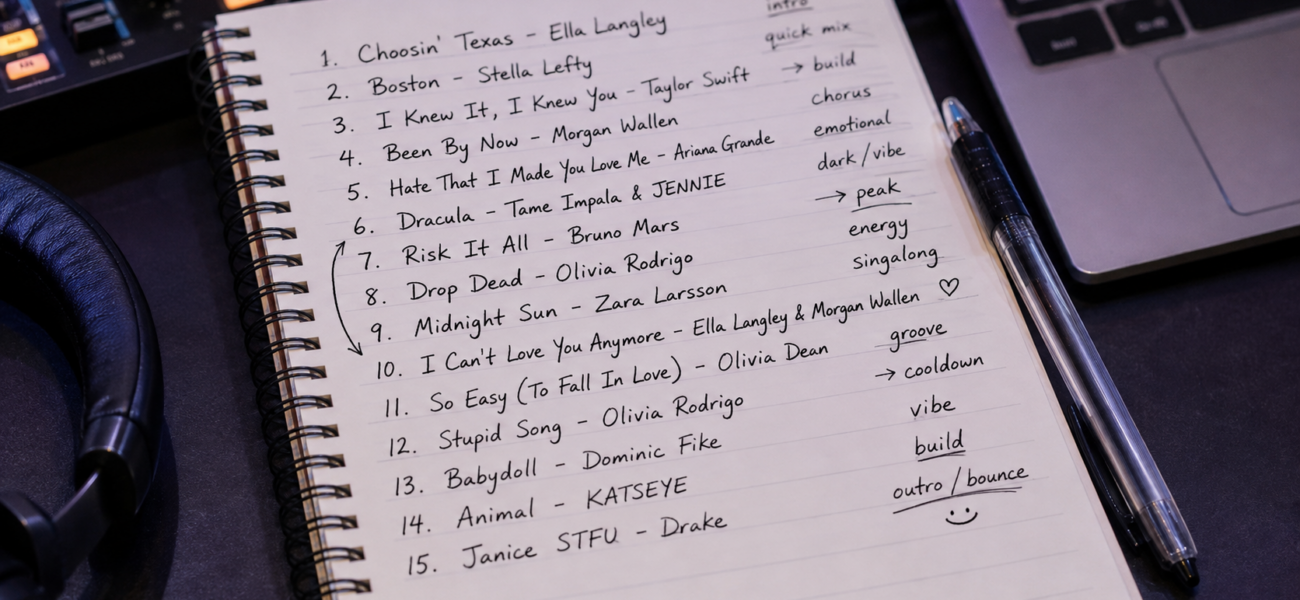
A setlist and a playlist are not the same thing. A playlist is a collection of tracks. A setlist is a strategic document — a plan for how a set will move through energy, genre, and emotion from the first track to the last. Done well, a setlist makes you faster, more confident, and more consistent under pressure. Done wrong, it becomes a cage that stops you from reading the room. Here’s how to create one that helps without constraining.
Why Most DJs Don’t Plan Sets (And Why They Should)
The romantic image of DJing is pure spontaneity — responding to the room in real time, pulling records from deep knowledge and instinct. That image is accurate for maybe the top 1% of experienced DJs at their best. For everyone else, some level of planning dramatically improves the quality and consistency of the set.
Planning doesn’t remove spontaneity. It creates a framework within which spontaneity can happen safely. You know your opening, you know your peak weapons, you know your crowd-savers — and within that structure, you can respond to the room freely because you’re not also trying to figure out where the set is going.
The Difference Between a Set Map and a Setlist
Set Map
- Defines the arc and phases
- Identifies key tracks for each phase
- Flexible — can adapt to the room
- More tracks than you’ll play
- Guides decisions, doesn’t dictate them
- Works for all gig types
Fixed Setlist
- Specific tracks in specific order
- Every transition pre-planned
- Rigid — hard to adapt live
- Exactly what you intend to play
- Dictates decisions, doesn’t guide them
- Works for recorded/broadcast sets
For live performance, a set map is almost always better than a fixed setlist. A fixed setlist makes sense for recorded sets, podcast mixes, and situations where you know exactly what context you’re playing for. For live gigs where crowd response matters, a set map gives you structure with flexibility.
Building Your Set Map
Before you pick a single track, decide the shape of the set. How long is it? When does energy peak? Is this a warm-up that ends before peak energy, a full arc from start to finish, or a closing set that starts at medium energy and builds to peak? Write this down as a simple energy graph: low → build → peak → resolution. Every track decision follows from this arc.
Identify 5–8 tracks that are your weapons for peak hour — your most crowd-tested, highest-energy records for this specific crowd type. These are the foundation of the set. Everything else exists to build toward them and resolve after them. Mark these clearly in your library.
Pick 3–5 possible opening tracks. Having multiple options means you can make the final call based on the room’s energy when you arrive rather than committing at home. Your opener sets the tone for everything that follows — it should establish your sound without demanding energy that isn’t there yet.
Identify 15–25 tracks that live in the build phase — progressively increasing energy, building toward your peak records. These don’t need to be in a specific order. Having a pool of build-phase tracks lets you respond to the crowd in real time while staying within the intended energy arc.
Pick 5–8 universally reliable tracks — records you know will work with almost any crowd. These are your emergency tools for when a direction isn’t landing. Mark them separately so you can access them instantly without searching.
Know how you want to end. The last 20–30 minutes of a set should feel intentional, not like you ran out of ideas. Have 5–8 closing tracks ready — records that feel like resolution, that bring the energy down gracefully, and that leave the crowd with a positive final impression.
Organizing Your Set Map in rekordbox or Serato
Both major platforms let you organize your set map natively without any extra tools:
- Create a gig playlist folder — name it with the date and venue: “2026-08-15 Club XYZ”
- Create sub-playlists within the folder: Openers, Build, Peak, Crowd-Savers, Close
- Add tracks to each sub-playlist during your prep session. More tracks than you’ll play in each category.
- In rekordbox: Use My Tag to mark tracks by their set role — “Peak”, “Build”, “Safe” — so you can filter on the fly at the gig
- In Serato: Use the crate system and colour coding to differentiate track types
The Written Set Map
Some DJs prefer a physical written set map — especially for weddings and events with scheduled moments. A simple card or note with:
- Timeline of key moments (first dance at 8:30, open dancing at 9:00)
- Confirmed must-play tracks and approximate timing
- 3–5 opening track options
- Peak weapons — the 5 biggest records for the night
- Emergency crowd-savers — underlined, easy to find at a glance
Keep this card visible in the booth. Not because you’ll follow it rigidly, but because having the arc visible prevents the tunnel vision that can happen after a few hours of performing under pressure.
Prepare more tracks than you could possibly play. Know your library deeply. Then, at the gig, let go of the plan and respond to the room. The preparation is what gives you the freedom to be spontaneous — because you’re drawing from a deep well of organized, ready tracks rather than scrambling to find something that works under pressure. The best sets feel improvised. They’re not.
Frequently Asked Questions
How far in advance should I plan my set?
For club and bar gigs: 24–48 hours is sufficient. For weddings and corporate events: 1–2 weeks minimum, to allow time to source any tracks you don’t have and confirm special song requirements. For recorded podcast or radio mixes: plan the entire set in advance, since there’s no live crowd to adapt to.
Should I plan transitions as well as tracks?
For a live set — no. Planning specific transitions in advance assumes a specific crowd response that may not materialize. Know which tracks can follow each other harmonically and energy-wise, but leave the exact transition decisions for the moment. For a recorded set, pre-planning transitions produces a more polished result.
What if the crowd wants something completely different from my plan?
Go with the crowd. The set map is a guide, not a contract. If the room is clearly responding better to a direction you didn’t plan for, adapt. A DJ who abandons a failing plan and finds what works is more impressive than a DJ who executes a perfect plan that the crowd isn’t feeling.
Tracks for Every Phase of Every Set
MyMP3Pool gives you the depth of catalog to populate every phase of your set map — openers, build tracks, peak weapons, and crowd-savers — all in one subscription.
Visit MyMP3Pool →
ⓘ Affiliate link — we may earn a commission at no extra cost to you
The Best DJ Record Pool We've Tested
After independently reviewing every major record pool, mp3poolonline.com consistently comes out on top for catalog size, audio quality, new release speed, and price.
Visit mp3poolonline.com →ⓘ Affiliate link — we may earn a commission at no extra cost to you