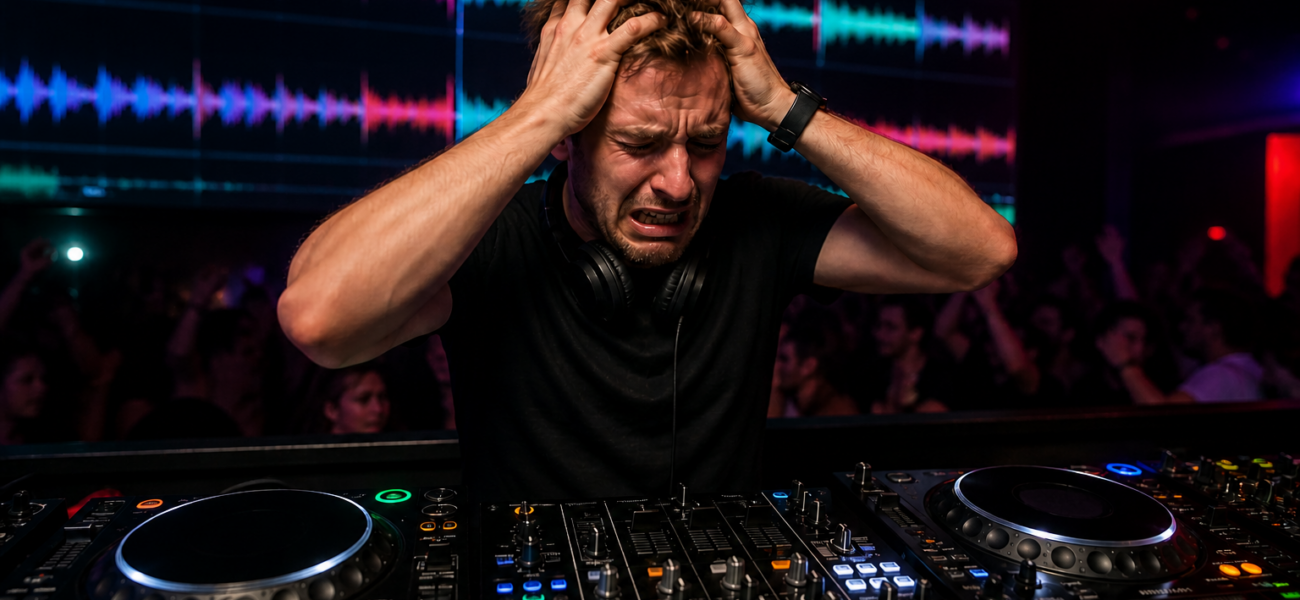
A trainwreck — two tracks badly out of sync, clashing beats tearing through the speakers while the crowd stares at you — is every DJ’s nightmare. The good news: they’re almost entirely preventable. And when they do happen, recovery is a skill that can be learned. Here’s how to stop them before they start, and how to get out cleanly when things go wrong.
What Causes a Trainwreck?
Trainwrecks have three root causes:
- BPM mismatch — the two tracks are running at different speeds, so the beats drift apart over time
- Phase mismatch — the BPM is right but the beats are offset, causing them to clash on every bar
- Timing error — the incoming track was released at the wrong beat, putting it structurally out of sync even if the tempo is correct
All three are preventable with the right habits. None of them are random.
The 5 Prevention Rules
Always Cue Before You Mix
Listen to the incoming track in your headphones and confirm it’s beatmatched before you open the channel fader. Never bring a track up before it’s synced. Give yourself a minimum of 8 bars of monitoring time — more is better. If you’re not sure it’s right, it’s not right.
Set a Cue Point at Your Mix-In Moment
Set a hot cue at the exact bar you want to bring the track in. When it’s time to mix, you can jump back to this point instantly if something goes wrong — rather than scrambling backwards through the track trying to find the right spot while the trainwreck builds.
Start Your Mix Attempt Early
Begin your mix attempt 4–8 bars earlier than you think you need to. This gives you recovery time if the first release isn’t right. DJs who attempt a mix at the absolute last second have zero margin for error. Give yourself room.
Always Have a Plan B Track Loaded
Before any mix, know two things: where you’re going in, and what you’re playing if it goes wrong. Have a safe track loaded in your head — something you can jump to quickly and confidently if the mix falls apart. The confident DJ always has an escape route.
Know Your Track Structures
Trainwrecks often happen when a DJ doesn’t know where the phrase boundaries are in a track. Always mix at the beginning of a new 8 or 16 bar phrase — a new verse, a drop, a chorus. Mixing mid-phrase sounds wrong even when the beats are perfectly aligned, and it makes recovery harder.
Common Trainwreck Scenarios (And How to Avoid Each)
Sync Said It Was Fine But It Drifted
Happens with live recordings, DJ edits, and tracks with variable BPM. The sync button locked in at the start but the track’s BPM shifted slightly.
→ Always monitor in headphones even when using sync. Keep one ear on the mix at all times. Adjust the pitch fader manually if you hear drift starting.
The Track Started on the Wrong Beat
Beats are matching but something sounds wrong — structurally off. The incoming track started on beat 2, 3, or 4 instead of the “1.”
→ Use your cue point to jump back to the downbeat and release again. This is why setting precise cue points before a gig matters — you can fix a wrong release in seconds.
You Rushed and Brought the Track Up Too Early
The fader was open before the track was properly synced, and now two unsynced tracks are playing through the speakers.
→ Kill the incoming track immediately. Don’t try to fix it through the speakers. Reset, re-cue, re-sync in headphones, try again.
The Outgoing Track Ended Before You Were Ready
The track ended — silence through the speakers, or a looping outro playing awkwardly.
→ Always know how long a track is and start your mix attempt before the outro begins. Set a visual reminder in your waveform — add a hot cue at the point where you MUST start mixing.
Recovery: When It Goes Wrong Live
Even experienced DJs have trainwrecks. Every DJ who has played enough sets has a story. The difference between a professional and a beginner isn’t whether trainwrecks happen — it’s how fast and calmly they’re fixed.
Step 1: Kill the incoming track immediately
The moment you hear a trainwreck developing, pull the fader on the incoming track down to zero. Don’t try to fix it while it’s playing through the speakers. One track playing cleanly is infinitely better than two tracks clashing.
Step 2: Stay calm — do not react visibly
Never look flustered, never call attention to the mistake, never apologize on the microphone. Most crowds don’t notice a quick cut. What they notice is a DJ who panics. Your body language tells the room whether or not something went wrong.
Step 3: Reset and try again
Jump back to your cue point, re-sync in headphones, and bring the track in again on the next phrase boundary. A second attempt that’s right quickly resets the crowd’s memory of the first attempt.
Step 4: Move to a safe track if you’re rattled
If the trainwreck has shaken your confidence, it’s better to play something you know well and regain your composure than to attempt another complex mix while you’re still flustered. Confidence in the booth is contagious — so is anxiety.
A trainwreck is a technical mistake, not a personal failure. Every DJ who has played enough sets has had them — including the DJs you admire most. What defines a professional isn’t perfection. It’s how fast and calmly you recover. The crowd follows your energy. If you stay calm and confident, they stay with you.
Building Habits That Make Trainwrecks Rare
- Pre-gig preparation — know your tracks. Set cue points at home, not at the venue. Familiar tracks are much easier to mix under pressure.
- Consistent workflow — develop the same pre-mix routine every time: cue, monitor, confirm sync, then open the fader. Make it automatic so you don’t skip steps under pressure.
- Practice under pressure — occasionally set a timer for 3 minutes and force yourself to complete a mix before it runs out. Simulated pressure builds the calm that real pressure requires.
- Record your practice sets — listening back to your own mixes reveals mistakes you missed in the moment. Patterns in your mistakes show you exactly what to work on.
- Play simple when in doubt — a clean, simple mix is always better than an ambitious, failed one. If you’re tired, uncomfortable with the equipment, or in an unfamiliar booth, simplify your mixing and play it safe.
Frequently Asked Questions
Is it normal to have trainwrecks when starting out?
Completely normal. Trainwrecks are part of the learning process. Every DJ has them early on — the goal is to make them rarer over time through better preparation and habits, not to be paralyzed by fear of them. The only way to get past them is to keep playing in front of people.
What’s worse — a trainwreck or a boring safe set?
Depends on the context. At a club gig, one recoverable trainwreck is far better than an overly cautious set that never risks anything interesting. At a wedding or corporate event, safety is paramount — a trainwreck at the first dance is unforgivable. Match your risk level to the context.
Can you trainwreck while using the sync button?
Yes. Sync handles BPM but can’t fix a wrong-phrase release, a track with variable tempo, or a poor mix-in decision. Sync reduces the probability of a BPM-related trainwreck but doesn’t eliminate all trainwreck risk. Understanding why trainwrecks happen keeps you prepared for the ones sync can’t prevent.
How do I stop fearing trainwrecks during a gig?
Have a clear recovery plan before every mix. Know your cue point, know your plan B track, and know exactly what you’ll do if it goes wrong. Fear of trainwrecks is mostly fear of the unknown — a clear plan makes the unknown known and the fear manageable.
Start Every Mix with Well-Tagged Tracks
Properly tagged tracks with accurate BPM metadata make your DJ software’s sync and analysis more reliable — fewer surprises, fewer trainwrecks. MyMP3Pool delivers tracks ready to go.
Visit MyMP3Pool →
ⓘ Affiliate link — we may earn a commission at no extra cost to you
The Best DJ Record Pool We've Tested
After independently reviewing every major record pool, mp3poolonline.com consistently comes out on top for catalog size, audio quality, new release speed, and price.
Visit mp3poolonline.com →ⓘ Affiliate link — we may earn a commission at no extra cost to you